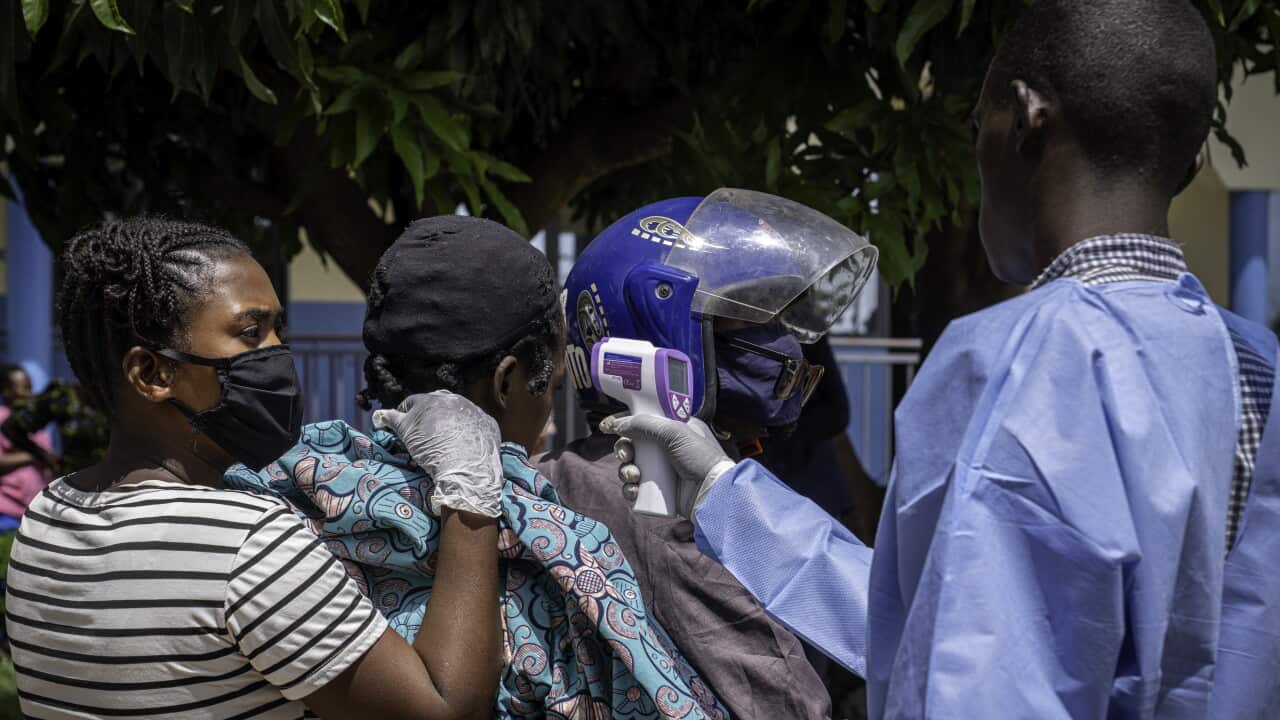
IN BRIEF
- It's the Congo's 17th outbreak of Ebola, and the largest with almost 4,400 cases confirmed.
- Around 70 per cent of fatalities are occurring without health intervention because of political distrust.
Ebola has killed more than 2,000 people in the Democratic Republic of Congo (DRC) in the latest outbreak, which is nearing the country's deadliest ever.
The current outbreak, which has hit the DRC's conflict-plagued eastern and northeastern regions, was declared on 15 May but is thought to have already been spreading for several weeks.
It is the DRC's 17th surge of the highly contagious disease and is already considered the largest in the country's history, and "could well become the largest outbreak ever", Sania Nishtar, chief executive of the Gavi global vaccine alliance, has said.
According to figures released on Tuesday by Congolese health authorities, 2,011 people have died in the latest outbreak, out of 4,381 confirmed cases of the virus.
The latest toll puts it close behind the DRC's deadliest Ebola outbreak in 2018 to 2020 when nearly 2,300 people died out of 3,500 recorded cases.
News that makes sense
Your trusted source for staying up-to-date with the world around you. Get free daily news updates and analysis, straight to your inbox.
The surge began in northeastern Ituri province and spread to several other provinces, notably North Kivu, regions where health infrastructure and a state presence are largely lacking.
The case fatality rate of the current outbreak is estimated by Congolese health authorities to be 45.9 per cent.
"We haven’t reached the peak yet," Health Minister Samuel Roger Kamba said in an interview shared on X by his ministry on Tuesday.
"Within the next three months, we expect to have already brought the spread under control and to start seeing it decline," he added.
'Slow' response
Insecurity due to the presence of armed groups and mistrust of the local population have hampered the response to the outbreak in the affected regions.
"We are only seeing 30 per cent [of infected people], where 70 per cent of people are dying at home. This is why this Ebola is different," Mohamed Yakub Janabi, the World Health Organisation's regional director for Africa, told reporters in Ituri's provincial capital, Bunia, on Monday.
Congolese virologist Jean-Jacques Muyembe, who helped discover Ebola in 1976, said in an interview with Tuesday's Le Monde newspaper that the response had been "slow and ineffective".
"There is an internal problem at the level of the national coordination of the response," he said.
"Everyone wanted to show they were doing something, even though nothing had actually been organised," he added.
Clinical trials
On Friday, WHO vaccine experts recommended a full-scale human trial of the only existing approved Ebola vaccine to see if it offered cross-protection against the strain of Ebola currently spreading in the DRC against which no specific vaccine currently exists.
The Ervebo vaccine has proved safe and efficacious against the more common Zaire strain of Ebola virus and WHO experts said that early data, notably from animal trials, showed it may also give some protection against the rare Bundibugyo strain exploding in the DRC.
The Gavi global vaccine alliance — set up in 2000 to help developing countries acquire affordable vaccines — maintains a stockpile of 500,000 Ervebo doses.
It said doses from the stockpile were to be made available for the trials, with some already in the DRC.
Two potential Bundibugyo vaccines are in the early stages of clinical trials on humans, while a third is being worked on to bring it to that stage.
Ebola is spread by contact with bodily fluids and causes a haemorrhagic fever.
It has killed more than 15,000 people in Africa in the last 50 years
For the latest from SBS News, download our app and subscribe to our newsletter.